


A 4 Axis Cnc Horizontal Machining Center combines horizontal spindle access with controlled rotary positioning. This arrangement expands machining flexibility without requiring a full five-axis system. It can reach multiple faces of a workpiece, often reducing manual repositioning and setup errors. Picture a steel housing rotating steadily while the cutter enters from the side. That movement is practical, not merely impressive.
Industry data explains why this equipment matters. The International Federation of Robotics reported 541,302 industrial robots were installed worldwide in 2023. That figure reflects manufacturing’s continuing shift toward repeatable, connected production. Deloitte’s 2024 Smart Manufacturing and Operations Survey found that 86% of surveyed manufacturing leaders viewed smart manufacturing as an important competitiveness driver. A 4 Axis Cnc Horizontal Machining Center fits this direction through automated workholding, probing, and production monitoring.
Still, automation does not remove every problem. Tool access can remain difficult around deep cavities. Rotary-axis accuracy also depends on calibration, thermal control, and operator experience. Small alignment errors may appear as visible mismatch on a finished surface. This is where judgment matters. The machine may offer impressive capability, but the correct choice depends on part geometry, batch size, materials, tolerance requirements, and available programming skills. This guide will explain how the fourth axis works, where horizontal machining creates advantages, and which limitations deserve careful review. Readers should treat published figures as market indicators, not guaranteed shop-floor results. Real performance varies.
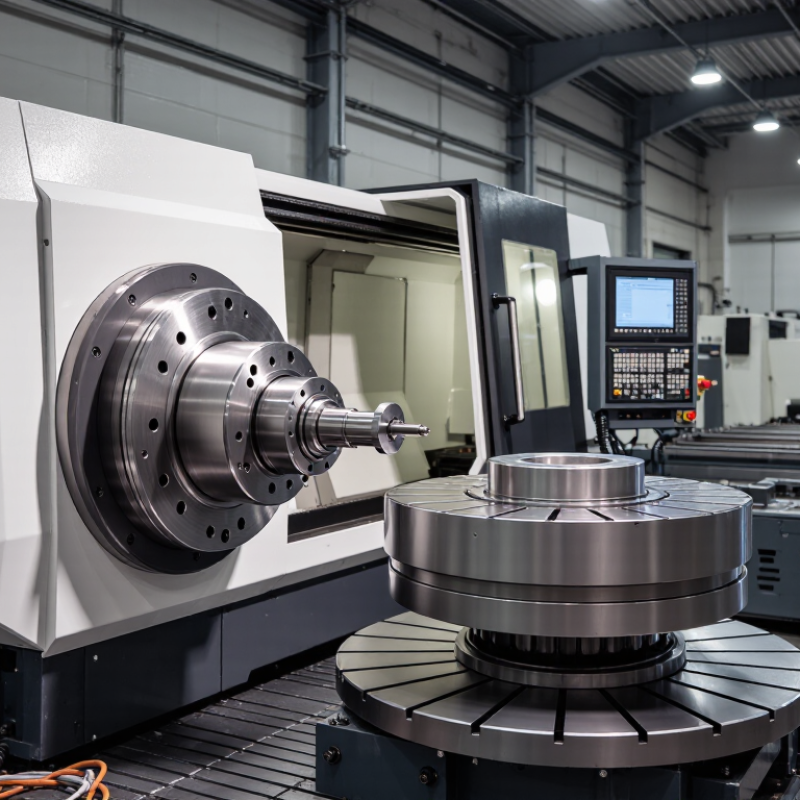
A 4-axis CNC horizontal machining center combines three linear axes with one rotary B-axis. X, Y, and Z position the cutting tool in three directions. The B-axis rotates the workpiece, usually around the machine’s Y-axis, although conventions can vary. This arrangement lets one fixture expose several faces without removing the part.
The rotary table is the practical core. It can index to 90-degree positions or move continuously during cutting. A sidewall pocket, cross-drilled hole, or angled surface becomes easier to reach. The horizontal spindle also improves chip evacuation, especially when coolant carries chips away from deep cavities. Shorter tool overhangs may reduce vibration. In real production, however, B-axis accuracy depends on calibration, backlash control, fixture rigidity, and thermal stability.
The International Federation of Robotics reported 4.28 million industrial robots operating worldwide in 2023. That figure reflects growing demand for repeatable, connected manufacturing. A four-axis center supports this trend through fewer setups and simpler automation handoffs. It is not automatically more accurate. Poor fixture design can still create angular errors, collisions, and uneven cutting forces. Operators should verify rotary-center offsets with probing and inspect the first completed part carefully. One overlooked detail remains important: B-axis programming becomes less intuitive when tool orientation changes during simultaneous motion. Training and simulation are still necessary.



North of Industrial Road, Linqing Economic Development Zone,Liaocheng City, Shandong Province, China
w.eric@lucimagnet.com
Eric: 0086-15688878114
Surface Grinder Machining Center CNC Lathe Machine Boring and Milling Machines
Semiconductor Optics Automobile Molding Construction Machinery Shipping Aerospace Valve Industry Wind Power Industry Abrasives Industry Refractory Industry Ceramic Seal Industry Bearings Industry
Company Patent Certificates Factory Tour Team Member Our Partner Our History Real-time Factory Inspection R&D Strength Terms & Conditions Privacy Statement


© 2025 Shandong Linmo CNC Machine tool Equipment Co.,Ltd. All Rights Reserved.